

Where No One Sees Me, An Elegy for Modern Man
By محمد علّام
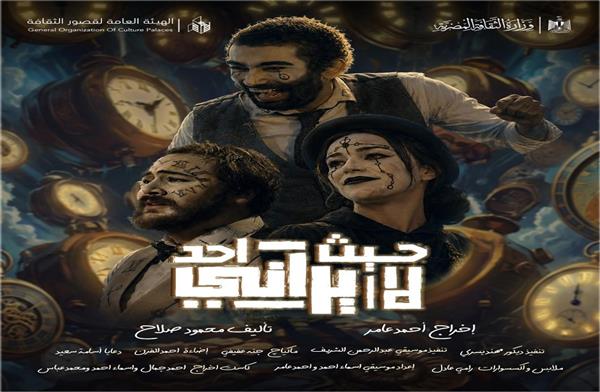
In the performance "Where No One Sees Me", which represents one of the Egyptian entries in the Cairo International Festival for Experimental Theatre, a highly sensitive treatment is presented regarding the futility of the twenty-first-century human. It explores the difficulty of pinpointing his place as he dissolves into the fabric of bureaucratic institutions, which constitute what we know as "civilization".
The events of "Where No One Sees Me" begin with a figure in worn gray attire, studded with gears across most of its fabric, moving with great difficulty. We later come to know him as the "Old Second Hand". He tells the audience, gathered around a hall-sized clock drawn on the floor, that he has grown weary of his steady rotation for twenty years. At that very moment, a young man in white enters, seeking the position of the "Second Hand". After passing the entrance exam, he takes over the job from the "Old Second Hand", who ultimately warns him that the role will cost him his loved ones and his connection to the outside world, ending in a desolate loneliness.
Mahmoud Salah, the director and author of the play, relies on a surrealist approach. He begins by proposing a hyper-real world, thrusting his characters into a cohesion devoid of a specific temporal context or a defined dramatic escalation. It is merely a moment of revelation experienced by a worker exhausted from performing a "futile" task. His life is spent spinning and spinning without anyone noticing him, without his life holding any value for himself or anyone else now.
The Sisyphus of the Twenty-First Century
The narrative intersects with numerous dramatic adaptations that have addressed the futility of life as the inevitable fate of modern man, whose value is no longer recognized, much like Albert Camus presented in The Stranger. It also reflects on what makes us capable of accepting the unacceptable, causing us to forget our humanity or cast it aside, as Bernard Da Costa proposed in "The Clockmaker Eva Braun". "Where No One Sees Me" can be considered an alternative adaptation of the Greek myth of Sisyphus, albeit through a distinct surrealist lens.
The performance relied on artistic techniques that distance us, the viewers, from traditional reality. It presents the world of clock hands living a life steeped in despair and frustration, carrying numerous defeats in their memories that vanish and evaporate with their disciplined, endless rotation.
The show heavily relies on the subconscious, presenting memories as dreams, obsessions, and visions where truths and illusions intertwine. We are left unsure whether the "Old Second Hand" truly sees his beloved or is merely hallucinating alongside the delusions of the "New Second Hand", who recalls his own lover in a blurred manner through entirely disjointed scenes.
Thus, the surreal world presented by "Where No One Sees Me" compels us to transcend the conventional boundaries of theater and immerse ourselves in an unconventional experience akin to alienation. This is especially true given the intense symbolism filling the theatrical space, such as gears, clocks, delirium in the rain, mechanical performance styles, and the portrayal of screaming as a wish and laughter as a forgotten state that the characters struggle to find amidst a job that strips them of their lives and personal histories.
The Subconscious and the Deconstruction of the Central Event
The merging of ideas and worlds is a purely surrealist technique. In moments of profound revelation, we sense that the two characters, the old and new second hands, are merely two sides of the same coin. They are an echo of a single tune composed of fears, pains, a sense of isolation, regret over lost loved ones, and repressed desires.
The performance avoids following a traditional plot based on a linear beginning and end. Instead, it intentionally makes the events disjointed or intertwined in an illogical manner to resemble the flow of dreams or thoughts in the subconscious. This is reflected in visual imagery reliant on costumes and decorative gear motifs anchored in the four corners of the performance space, making the concept of facing mirrors a mere repetitive reinforcement of what has already been established through dialogue, performance, and symbol.
The actors focus on experimental performance by employing strange physical movements or expressive acting that occasionally mimics the motion of clock hands. The level of strangeness in the characters' speech is commendable. Although it is an illogical language that may sometimes feel contrived, filled with metaphors and allegories that defy clear interpretation, making the characters' speech seem like part of an eternal, deep-rooted dream with no known beginning or end, it is perfectly suited to the nature of this surreal atmosphere charged with oddity and irrationality.
Logic in an Unconventional Theatrical Space
The show aims to stimulate the viewer's subconscious, urging them to think and contemplate the depths of the human soul through imaginary worlds and unconventional methods.
The performance was staged in a theatrical space resembling a small room, achieving direct and intimate interaction between the actors and the audience. The acting area was mapped out as a circle with clock numbers drawn on it, and the actors, with their mechanical movements, formed its hands. This helped engage the audience's various senses, such as sound, light, and touch, making them fully live the experience, enhancing the emotional impact, and rendering the overall experience more realistic.
Director Mahmoud Salah utilized unconventional tools, reflecting his ability to manage this distinct theatrical space and capitalize on the dynamic of direct live communication between the audience and the actors. The actors' positions were sometimes changed to share the same seats with the audience, or different corners of the room were used to perform scenes. Given the small spaces typical of such performances, simple yet effective lighting and sound tools are often used to enhance the general atmosphere, a feat the director accomplished without resorting to complex technology.
Is Civilization a Form of Slavery?
There is a strange contrast between the demands of civilization, which was incidentally built by man, and the demands of man as a free body and soul seeking to disown this era and this very civilization he built with his own hands.
We must not overlook the play's reference to bureaucratic systems, considering the relationship between clock hands as one of the most bureaucratic of all. The struggle against bureaucracy is a struggle against all the modern fortifications it has erected above everything else. As André Breton says, societies are born in religion and end in bureaucracy!
What we know about ourselves and the surrounding universe is minuscule compared to the actual size of the cosmos. While we humans view ourselves as the most complex beings, there may be other things elsewhere that are even more complex. Our brains are designed to understand mating, hunting, and raising children, essentially a world of medium-sized objects moving at moderate speeds in a three-dimensional realm. But how did all these things come to exist, and how did we reach this level of complexity?
It is easy for people to bow their heads in dissatisfaction, yet a cow does not revolt if the pasture is good. If people are treated like cows, they are forced to acquire a sense of contentment, even though it is the feeling of dissatisfaction that made history. It can be said that "Where No One Sees Me" is an attempt to present a human being who has a voice, a human whose pains history neglected to mention and whom no one can hear. We truly still need new means to listen to what the marginalized and forgotten might one day say.
Rate this article
Comments (0)
No comments yet.